Paraguay's Banking Crisis: Would You Still Apply for Residency?
One young bank failed. Depositors are already reporting the first repayments.
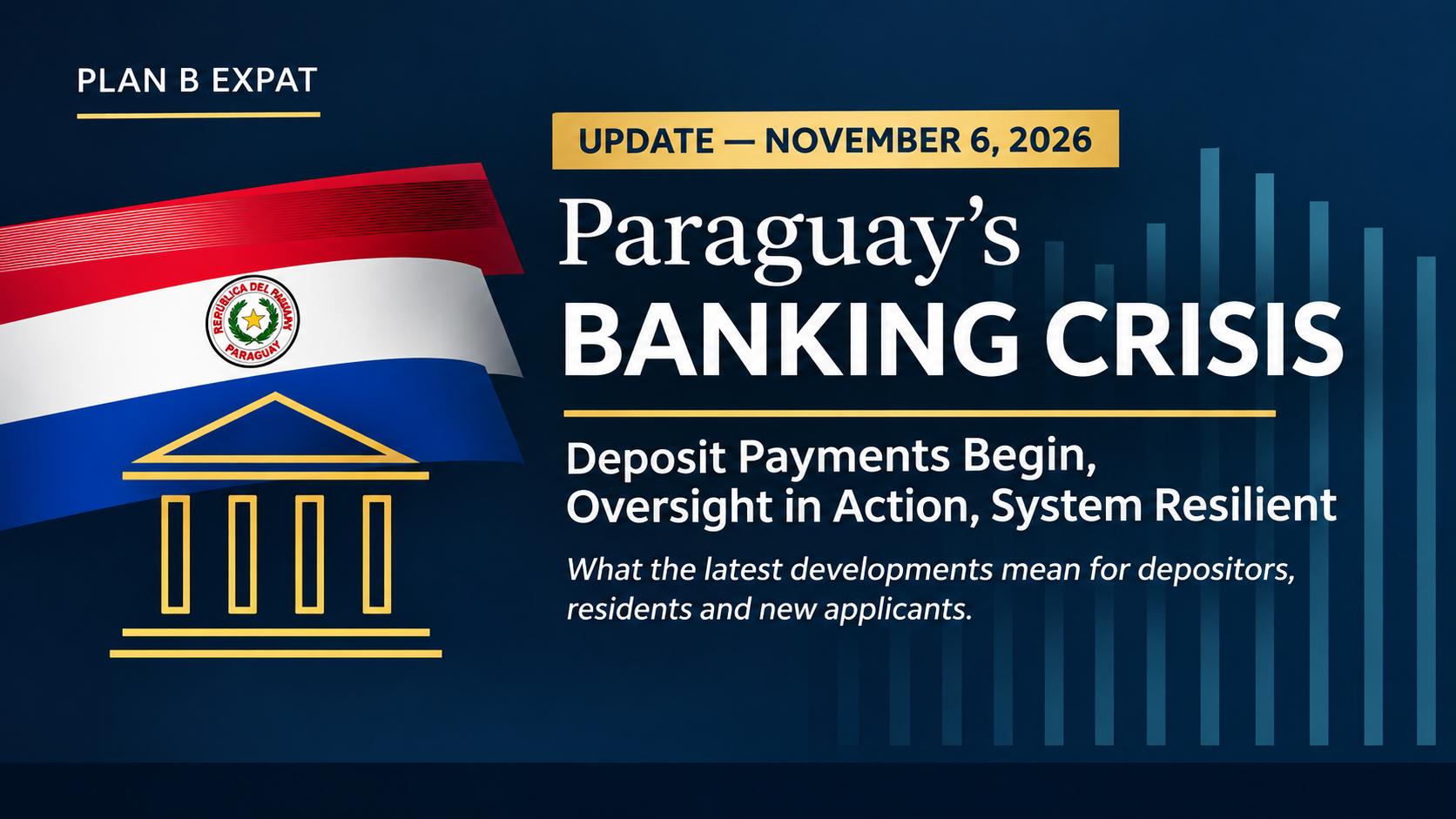
Ueno Bank's collapse has hurt customers and created a political crisis reaching Paraguay's president. It also offers a test of whether the country's banking laws can protect depositors when a bank fails. By November 6, the Deposit Guarantee Fund had sent money to participating banks, with some customers already reporting credits to their accounts. The Central Bank has also opened a depositor lookup service, giving customers a way to check their assigned bank. These are early results from a system established years before Ueno became a bank.
Paraguay's larger, long-established banks remain outside the resolution process affecting Ueno. Continental, Sudameris and Itaú continue operating, while the Central Bank has rejected rumours of further interventions. Reports from people Plan B Expat has contacted in Paraguay have also been reassuring about those institutions. Ueno's failure raises serious questions about its supervision, but it hasn't demonstrated that Paraguay's wider banking system is failing.
How did Ueno's failure reach the president?
Ueno became a bank in December 2023 and expanded rapidly after absorbing the established Visión Banco in 2024. On November 2, Paraguay's Central Bank voted to begin bank resolution, the legal process for dealing with a failed institution and protecting eligible depositors. The regulator found that Ueno's solvency ratio had fallen below half the required minimum after corrections to its financial statements. Customers suddenly lost normal access to money they needed for everyday expenses.
President Santiago Peña previously owned an interest in a group linked to Ueno's owners. His government has also faced scrutiny over public and pension money deposited at the bank and his appointment of Carlos Carvallo, a former Ueno executive, to lead the Central Bank. Carvallo resigned during the crisis. Lawmakers have alleged conflicts of interest and preferential treatment, although Peña denies wrongdoing and says he sold his financial interest in 2025. The allegations are still being investigated and do not establish his personal criminal responsibility.
Peña submitted his resignation on November 5 as Paraguay's Chamber of Deputies voted 78-0 to advance impeachment proceedings. Congress did not accept the resignation, and Senate proceedings continued on November 6. The scrutiny now reaches decisions about bank supervision and public funds as well as the presidency. That is significant in a country where the failure involves an institution with political connections, even though the constitutional process is still underway.
Paraguay's banking safeguards are producing results
Paraguay established its Deposit Guarantee Fund and bank-resolution rules in 2003. Under that law, a bank becomes subject to resolution when its solvency ratio falls below half the legal minimum. The Central Bank must begin the process within 24 hours of learning that a legal trigger has occurred. The 50% figure concerns financial capital relative to the required minimum, rather than cash held against customer deposits. The authorities have used these longstanding powers against Ueno despite its political connections. Public notices don't establish when the regulator first learned of the capital breach, so they don't settle whether that precise deadline was met.
The fund protects eligible deposits up to 75 monthly minimum wages, currently ₲228.3 million per depositor at each covered institution. A new emergency measure allows advances of up to 40 monthly minimum wages, or ₲121.76 million, with overdue debts deducted. The first payment group includes customers with deposits up to ₲10 million, no outstanding Ueno debt and an active account at another Paraguayan institution. In that group, customers whose entire balance is within the limit are eligible to receive it in full.
The response has now moved beyond announcements. Paraguayan reporting on the Central Bank's briefing says roughly ₲197 billion was transferred from the Deposit Guarantee Fund to participating financial institutions to begin repayments. On November 6, fund director José Maciel confirmed that receiving banks had been given the money for distribution. Local reporting identified approximately 322,000 depositors in the first payment group, with payments scheduled over five business days beginning November 5. Banks have begun processing credits, and Paraguayan newspapers have reported individual customers seeing money in their accounts. There wasn't yet an official tally of completed repayments when Maciel spoke on the morning of November 6.
For approximately 262,000 Ueno customers who have no account at another bank, the authorities are arranging accounts at participating institutions so their guaranteed payments can be credited. Customers with overdue loan instalments will have the applicable amounts deducted before receiving their payment. Rather than trying to process everyone at once, the Central Bank is using groups to avoid overwhelming the payment system. It has also opened an official depositor lookup to identify the institution assigned to handle each payment. Depositors should enter their details only through the Central Bank's official website and check their receiving-bank balance before relying on the funds.
On November 4, the Central Bank reaffirmed that the broader banking system maintained adequate liquidity and solvency, and rejected rumours of other interventions. A separate decision on November 5 lifted the redemption suspension affecting the BNB PY US Dollar Mutual Fund, although that fund is distinct from Ueno and its deposit guarantee. Continental, Sudameris and Itaú continue operating outside Ueno's resolution. The first transfers and public payment instructions show the wider financial system handling this failure through established procedures.
Much larger financial centres have also dealt with failed banks. European authorities resolved Spain's Banco Popular in 2017, while US regulators closed Silicon Valley Bank in 2023 and arranged access to deposits. Neither case was identical to Ueno's, and Paraguay still needs to examine why earlier supervision didn't prevent the deterioration. Paraguay's banking laws are now being enforced, and customers can check which bank is handling their payment. The public instructions and early repayments offer evidence of transparency and accountability, with more progress already visible than the initial headlines suggested.
What does the crisis mean for your residency?
Holding residency in another country doesn't require moving your entire financial life there. Someone already living in Panama, for example, might obtain Paraguayan permanent residency to preserve an option for retirement or a later move. Their main home and savings can remain elsewhere. The benefit is having permission to live in Paraguay if circumstances change, without committing to relocation today.
There is no general requirement to maintain substantial deposits in a Paraguayan bank merely to keep existing permanent residency. New applicants must still meet the financial conditions of their chosen immigration route, including the documentation rules introduced in July 2026. Permanent residents also need to follow Paraguay's absence rules. An unjustified absence of more than three consecutive years can lead to cancellation, and anyone planning a longer absence should check the procedure for prior authorization.
After permanent residency and a Paraguayan cédula are obtained, an everyday account with an established bank can make local life easier. Continental and Sudameris ranked among the country's largest banks by deposits before Ueno's collapse, although each bank makes its own account-opening decisions. A local account can cover electricity, mobile service and internet while a resident continues managing other savings and investments in the jurisdictions they choose. Residency and banking can support each other without requiring an immediate transfer of someone's entire financial life.
Would Plan B Expat still proceed with a residency application?
Yes, where the applicant qualifies and Paraguay fits the plan. Ueno's failure hasn't suspended the country's immigration routes or automatically cancelled existing residence permits. The Central Bank has invoked its longstanding resolution powers, the Deposit Guarantee Fund has sent money to other banks, and initial customer repayments are being reported. The repayment operation provides visible results, while established banks continue operating and political allegations are examined in public.
Plan B Expat helps applicants identify a viable residency route before committing to more involved preparation. A permanent resident can use an established Paraguayan bank for ordinary local expenses while keeping the rest of their financial arrangements where they suit them best. Paraguay continues to offer another country where a qualifying person can legally live, even without moving there immediately. For someone who wants that option, Plan B Expat would still recommend proceeding with a suitable Paraguayan residency application.
Information verified against official announcements and reporting available November 6, 2026. Payment figures refer to the opening stages of the process and may be updated.
Plan B Expat provides consulting and coordination, not legal or tax advice. Always take counsel from the licensed attorneys, accountants and tax specialists in our vetted network.
Sources and official records
Michael L.
Canadian founder of Plan B Expat and a permanent resident of both Panama and Paraguay. Holds an MBA from SKEMA Business School, France, is trilingual (English, French, Spanish), and spent 21 years as a licensed real estate broker in Quebec and Ontario. Writes from direct experience with the immigration, banking, and relocation systems of both countries.