
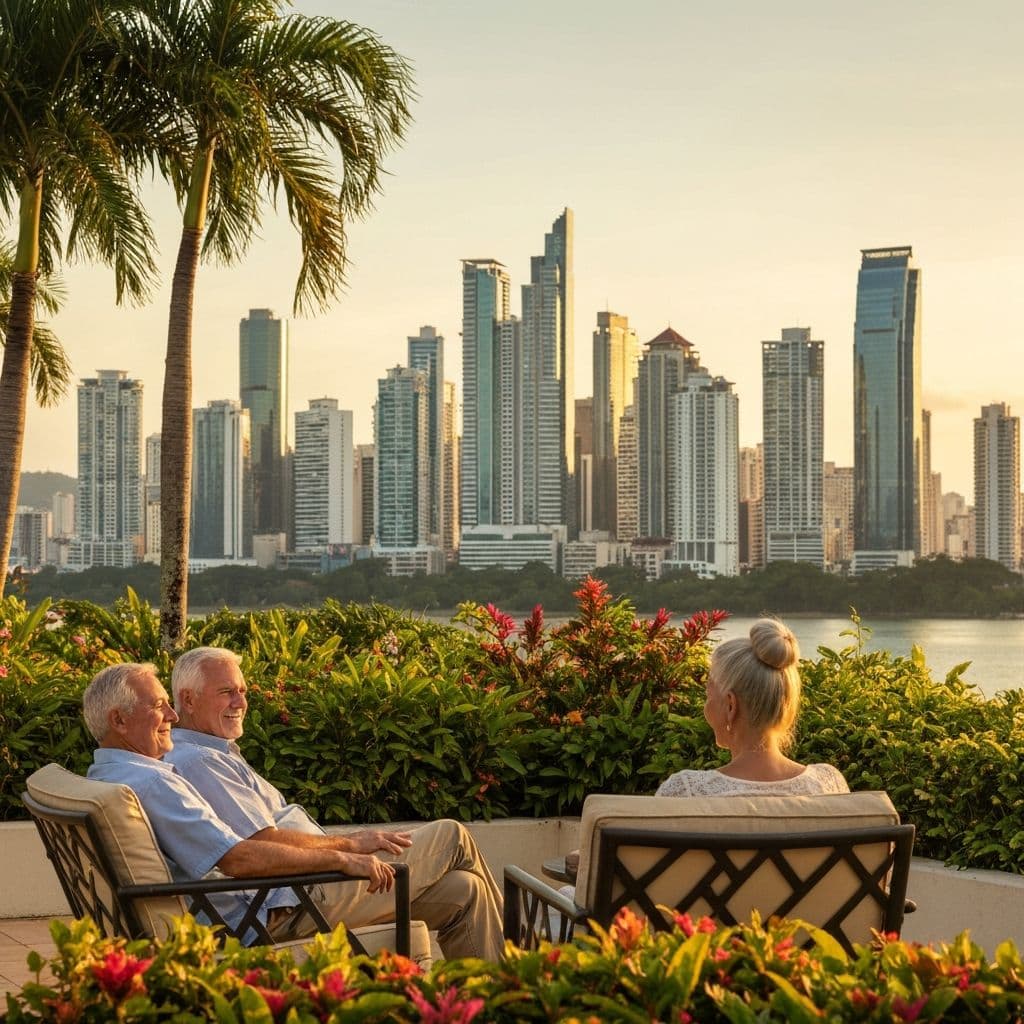
Panama Is Working on a New Retiree Benefits Law. What Pensionado Applicants Should Know
Panama's Assembly approved a major expansion of retiree benefits. President Jose Raul Mulino does not want that bill in its current form and is now pushing for a different law.
Status as of September 15, 2026: nothing has been decided.
Panama's National Assembly approved Project 226 in third debate on August 27, with 47 votes in favor and one against. The proposal would expand benefits under Law 6 of 1987, the law behind Panama's discounts for retirees, pensioners and older residents.
But Project 226 is no longer the best guide to what the final law may look like.
On September 15, President Jose Raul Mulino called the Assembly version a "bad law" and said his government was working toward a new consensus text with retiree groups, business representatives and other affected sectors. His stated goal is to have a new law approved before October 31, when the current legislative period closes.
That date belongs to Panama's legislative calendar. It is not a deadline for anyone considering residency.
The Assembly passed an expansion. The president does not want it in that form. The question now is which parts survive into the law his government is trying to build.
The Pensionado residency program has not changed
Panama's Jubilado Pensionado category grants permanent residence directly. The requirement is a lifetime pension of at least US$1,000 a month, paid by a foreign government, an international organization or a private company, and certified as being for life and currently in payment.
Each dependant needs an additional US$250 a month in solvency, which can be evidenced by a further pension or by a local bank reference.
Spouses may combine both pensions to reach the US$1,000 minimum, and the minimum stays at US$1,000 when they do. A couple combining pensions does not need US$1,250 because there are two of them.
There is also a property exception that is frequently misstated online. Where the applicant personally owns Panamanian property worth more than US$100,000, the pension minimum drops to US$750.
The permit is granted indefinitely and needs no renewal.
None of the current negotiations over retiree discounts changes these Pensionado immigration requirements.
What the Assembly wanted to expand
The medicine proposal is one of the clearest examples. Law 6 currently provides a 20% pharmacy discount on medicines. The Assembly version would raise that to 30%.
Internet would also be added as a new benefit category. Current Law 6 covers the fixed charge on one residential landline but excludes internet, cellular and cable services.
The home-mortgage provision would move from a one-percentage-point reduction in the interest rate on a qualifying mortgage for the beneficiary's own home to two percentage points.
Project 226 also proposed additional benefits involving adult diapers, wheelchairs, walkers and other products used disproportionately by older people.
None of those proposed increases can be demanded today.
Until Panama enacts and publishes a replacement law, the current Law 6 schedule remains in force.
Why businesses pushed back
The dispute is not about whether retirees should receive more.
Businesses have focused heavily on how the discounts are financed. The Assembly version would allow benefits granted under the expanded law to be claimed as a fiscal credit against income tax. Under the current system, the fiscal-credit mechanism applies much more narrowly, including the restaurant and fast-food discounts.
For a business, however, giving a discount today and recovering its value later through the tax system are two different cash events. Pharmacies, hotels and other operators still have payroll, rent, inventory and suppliers to pay in the meantime.
That is one reason the government brought retirees and business groups back to the table rather than signing the Assembly version as written.
The September 15 discussions included electricity, public transportation, telephone service, healthcare, adult diapers, wheelchairs and walkers. Participants also questioned whether some tourism and hotel benefits do as much for lower-income older adults as relief on everyday expenses.
That discussion may influence the replacement text. It does not tell us what the final law will contain.
You do not need the Pensionado visa to qualify by age
Most people assume these discounts belong to the Pensionado visa. They do not.
Law 6 covers Panamanians and foreign residents from age 55 for a woman and 60 for a man, and separately covers anyone who is retired or drawing a pension, at any age. Two different doors into the same schedule.
That matters if you came to Panama another way. Someone who took Friendly Nations, Qualified Investor or the self-solvency route reaches 55 or 60 and qualifies on age alone, with no pension to prove and nothing to certify beyond the cedula.
The documentation ACODECO publishes for foreigners, legalized and translated, applies to someone claiming as a pensioner on a foreign pension. It does not attach to the age claim.
And the current schedule is worth knowing.
A qualifying beneficiary receives 25% off domestic and international air tickets, including online bookings.
Hotels are 50% off Monday to Thursday and 30% Friday to Sunday. At all-inclusive properties, the discounts are instead 20% Monday to Thursday and 12% Friday to Sunday.
Medicines at pharmacies are discounted 20%, with no prescription required for the discount itself. Doctors' fees receive 20%, while private hospitals and clinics are discounted 15% on the total bill.
Restaurants give 25% off the beneficiary's own individual consumption. That means what the qualifying person personally ate and drank, not 25% off the entire table because one person qualifies.
Cinema, theater and sporting events are discounted 50%. Residential electricity receives a 25% discount up to 600 kWh, and passports receive a 50% discount.
These are benefits available under the current schedule, not Project 226 proposals.
There are two limits worth knowing.
Permanent residence is the cleaner position. Provisional status can attract questions, so we would not build a retirement budget around receiving these discounts during a two-year provisional stage.
Eligibility is also personal. A younger spouse with no pension of her own does not receive the discounts because her spouse qualifies. She becomes eligible through her own status when she reaches 55.
Permanent residence could become more explicit
The Assembly-approved version reportedly makes permanent residence explicit for foreign beneficiaries.
That could put a clearer line around an issue that already arises in practice. It would matter most to foreigners living in Panama during a provisional or temporary stage.
Pensionado applicants are in a different position because Jubilado Pensionado grants permanent residence directly.
The same may be true for clients who obtained permanent residence through another route and later qualify for Law 6 through age.
Since Mulino's government is now working on a different text, we would not treat the Assembly wording as final. The permanent-residence provision needs to be checked again when the replacement law is enacted and published.
Why this reaches beyond Pensionado clients
For someone coming to Plan B Expat with qualifying lifetime pension income, the residency analysis has not changed. We look at the pension, dependants, documentation and the immigration requirements that are in force now.
But this legislation reaches a much wider group of foreign residents.
Someone who became resident through Friendly Nations, Qualified Investor, self-solvency or another route may never have thought of themselves as a pensionado. Once that person reaches the Law 6 age threshold, the same statutory discount schedule can become relevant.
For people planning retirement expenses, those percentages are not trivia. Medicine, medical care, electricity, restaurants, airfare and travel add up over a year.
The existing benefits are already real. The Assembly wanted to make some of them larger. Mulino wants a different law. Those are three separate facts, and until a new text is enacted they should stay separate.
Should a new Pensionado applicant wait?
Nothing in the September 15 position changes the current Pensionado immigration requirements or requires a qualified applicant to postpone an application.
October 31 is not a Pensionado deadline. It is the end of the legislative period in which Mulino wants the government, retirees and businesses to reach agreement on a replacement law.
For a prospective Pensionado applicant, the residency question can be answered now.
The final shape of Panama's new retiree-benefits law cannot.
Considering Panama's Pensionado residency?
Plan B Expat can assess whether your pension and family structure fit the current Pensionado requirements, identify the documents required for your application and coordinate the process before you travel.
[Get Started]
Michael L.
Canadian founder of Plan B Expat. Permanent resident of both Panama and Paraguay. MBA in International Business, trilingual (English, French, Spanish), and two decades of real estate brokerage experience in Quebec and Ontario. Writes from direct experience navigating the immigration, banking, and relocation systems of both countries.