
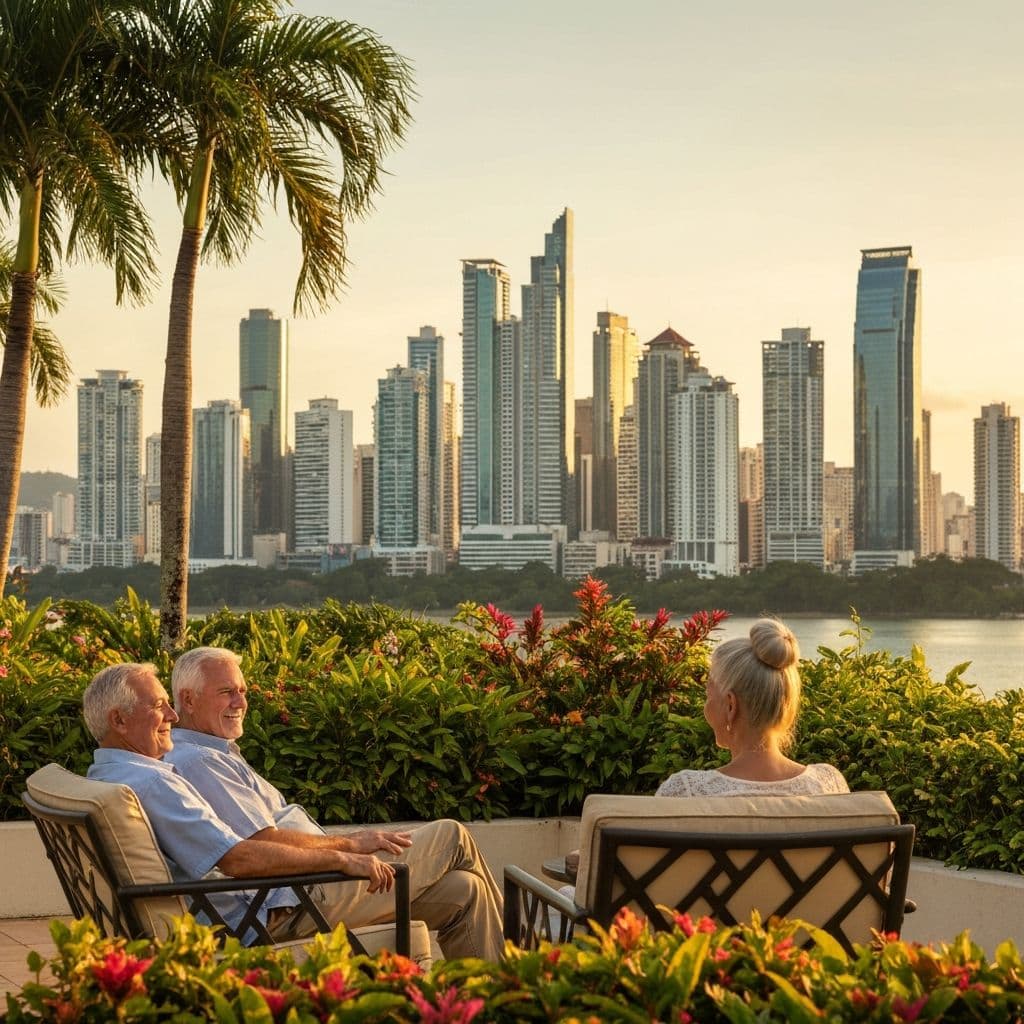
Most retirement visas make you wait years for permanent status. Panama grants it directly, with no provisional stage in front of it.
Prove $1,000 a month in lifetime pension income, and Social Security counts, and you skip the two-year provisional period other routes impose. You also get the statutory discounts under Law 6 of 1987, which run from 15% to 50% across restaurants, flights, hotels, medicine and more.
I hold residency in both Panama and Paraguay. The Pensionado is the best retirement visa I have seen in the Americas. Here is how it works, listed from the law, not the brochures.
The bar is lower than you think
Income Requirements
The Pensionado requires proof of lifetime pension or retirement income. There are two ways to reach it.
Standard path:
Property combination path:
The wording is doing work on that second path. The immigration service's published requirements set out four exceptions to the standard rule, and the first says that where the applicant has acquired a property a título personal in national territory for a sum exceeding B/.100,000, the pension may be a minimum of B/.750.
Two details live inside that sentence. A título personal means in your own name, not through a company or a foundation. And exceeding means above $100,000 rather than at it, so a property valued at exactly $100,000 does not qualify.
The legal basis is Executive Decree 320 of 8 August 2008, articles 200 to 203, as modified by Executive Decree 26 of 2 March 2009. That 2009 amendment is what makes this route grant permanent residence directly. The immigration status is indefinite and does not require an extension.
A correction, since an earlier version of this article said otherwise. We previously published $200,000 on the strength of a lawyer's recollection, and told readers the widely quoted $100,000 was wrong. That was backwards. The requirements sheet is the primary source and it says $100,000.
What counts as a pension. A certified lifetime pension from a recognized institution. A private retirement arrangement can qualify where the administering institution certifies that it produces a guaranteed lifetime pension and supplies the institutional and payment evidence the requirements list. Ordinary 401(k) or IRA withdrawals, investment income, rental income and self-directed distributions are not the same thing, however reliable they are. Disability income qualifies only where the issuing institution certifies it as a lifetime pension meeting the rule.
The pension must already be in payment. Panama does not accept a projected or expected entitlement. A letter saying your pension begins next year won't support an application. The date it starts paying is the date this route opens.
Two mechanisms, and one is better than the other
Adding a Spouse
There are two ways to bring a spouse in, and they are not equivalent.
One pension plus a dependent. The principal certifies their own pension and adds $250 a month of solvency for the dependent, so $1,250 in total. That extra $250 doesn't have to come from the principal's own pension: the requirements allow it to be evidenced by an additional pension or by a local bank reference.
Combining both pensions. The requirements state, as the second exception, that in the case of spouses the sums of both may be credited to meet the established minimum of B/.1,000. Counsel has confirmed in writing that when this exception is used the minimum stays at B/.1,000 and is not raised to B/.1,250 because one spouse figures as a dependent.
So combining is the better mechanism where both spouses draw a pension. A couple each receiving $600 a month clears the $1,000 threshold on the combined $1,200, where neither could alone, and they don't need to find another $250.
Structurally it stays one application. One spouse is the principal applicant, the other a dependent spouse, and both pension certifications go into the same file together with the marriage certificate.
What none of this changes is the timing rule above. Both pensions have to be in payment and certified for life. A pension starting next year can't be added to this year's application.
The part that catches families
Children and Dependents
A dependent child can be included, and the result is narrower than families expect.
The published requirements state that a dependent child's permit is temporary until age 25, provided the child proves regular full-time study, and that the child does not acquire the right to permanence and does not acquire pensionado status. The only exception is a proven severe disability, which the requirements describe using the Spanish term discapacidad profunda.
So a child on a parent's Pensionado file doesn't reach permanent residency through it. Nor does dependency by itself create Law 6 eligibility: the child would have to qualify independently, by meeting the age threshold or by holding a qualifying disability or survivor's pension. An adult child who wants permanent status in Panama needs a category of their own.
This is why retirees choose Panama
The Famous Pensionado Discounts
The discounts come from Law 6 of 16 June 1987 as amended, and the schedule below is taken from ACODECO's own application manual, not from the versions circulating online. ACODECO is the consumer authority that enforces it.
Who qualifies for them. Women from 55 and men from 60, or anyone who is a jubilado or pensionado of any gender. The manual states expressly that beneficiaries may be foreigners or Panamanians pensioned in another country, provided the condition can be evidenced, and that pensioners by disability or survivorship qualify regardless of age.
That produces two separate doors, and most people only know about one.
By age. A foreign resident who has reached 55 as a woman or 60 as a man can claim the discounts on age alone. Our counsel confirms that no pension has to be proved where the benefit is claimed on that basis. The cédula establishes both age and residence. So a resident with no pension at all still gets them once the birthday arrives.
By pensioner status. A Pensionado holder gets them even below those ages, because the benefit is also recognized for being a jubilado or pensionado. Here the documentation matters: ACODECO's requirement for legalized Spanish-language paperwork applies where a foreigner is proving that status through a pension granted abroad.
One caution on residency type. Counsel's advice is that the residence should formally evidence the condition. Permanent residence does not usually cause difficulty. Some provisional residencies can attract observations depending on the case. So if you are on a two-year provisional route rather than Pensionado, treat the discounts as something to confirm rather than assume.
Travel and leisure
Eating out
Health
Money and property
Utilities
Other
These discounts are mandatory, not voluntary. ACODECO hears complaints against businesses that refuse them and requires every public establishment to display the discounts visibly. Present your cédula or pensioner card when you ask, and take a refusal to ACODECO. Their complaints line is 6330-3333.
One rule worth knowing: the benefit applies to the regular price. Where an item is already on promotion, you choose between the promotion and the Law 6 discount rather than stacking them.
Import exemptions come from Law 9 of 1987 rather than Law 6. A one-time exemption from customs duty on household and personal goods up to $10,000, and an exemption from customs duty every two years on one vehicle for personal or family use. These are duty exemptions, not free goods, and selling, leasing or transferring an imported item without paying the applicable taxes is restricted.
The paperwork isn't bad, unless you have a private pension
Required Documents
Article 28 of Decree Law 3 asks for an authenticated copy of the passport, either compared by a Panamanian notary or certified by the diplomatic mission or the issuing authority. Counsel's filing instructions for this route may require a notarized passport copy to be apostilled or otherwise authenticated on top of that, so follow the document format specified for your own file. A firm can ask for more than the statutory minimum.
All applicants:
A dependent spouse needs the relationship documents, and counsel's filing list adds an apostilled birth certificate less than three months old plus an apostilled criminal record.
Private pension holders also file:
Some firms also ask for three months of statements and a certificate that the company is authorized to administer pensions. Those are filing preferences, not items on the published list.
On document validity. A criminal record check often has no expiry of its own. Counsel applies three months from the date of issue, and the clock starts when the certificate is issued, not when it is apostilled or filed. Order it too early and it lapses before filing. Settle your travel dates first, then order.
On the pension certification, the wording decides more than the amount does. A statement of your current monthly payment isn't enough on its own. The certification has to establish that the income is permanent or for life, that it is currently in payment, and the monthly amount. Letters that omit the lifetime element have stalled files for weeks.
Canadians can relax about this one. Counsel confirms that the immigration service is familiar with standard Service Canada benefit statements, presented apostilled and translated, even though they rarely use the word "lifetime" outright. Order the standard statement rather than chasing custom wording.
If the certification is not in US dollars, that isn't a problem. Foreign currency is expressly accepted.
Two trips, or three without the priority cédula appointment
Application Process
Step 1: Document preparation. Gather and apostille everything at home. Time it against your travel dates instead of starting as early as possible.
Step 2: First Panama visit. Four to five business days. You file, give biometrics and obtain your health certificate in Panama. You leave with a carné de trámite valid six months, which evidences your legal stay while the file is decided.
Step 3: Processing. Decree Law 3 sets a decision period of no more than 60 business days for residence applications, with a 15-business-day window to correct an incomplete file. Counsel currently estimates around three months for a complete Pensionado file. Government queues are outside anyone's control, and the authority can ask for more documents.
Step 4: Second Panama visit. Around two days, and both applicants attend in person. You collect the resolution and receive your permanent resident cards.
Step 5: The cédula. Two separate waits live here, and conflating them is what produces the timelines you see quoted elsewhere.
The first is getting an appointment at the Electoral Tribunal. There is no fixed period for it. The wait depends on appointment availability and the workload at the time, which is why our counsel declines to promise a number of days and why you should distrust anyone who does.
The second is easier. Once an appointment has been assigned, you have up to two years to attend, take the photograph and complete the issuance. So the card is not something that expires out from under you while you are back home.
The cédula appointment is not a way out of appearing. You attend the Tribunal Electoral in person either way, because the photograph and signature are taken there and nobody can stand in for you. The only open question is whether your appointment falls while you are still in Panama or after you have flown home. If it lands after you fly home, it means going back.
That is what the optional priority appointment service exists for. It shortens the wait for a slot, bringing it forward to the day after your permanent card is issued, so the appearance can be grouped into the trip you are already making rather than left to a date nobody can predict. It changes when you attend, not whether you attend. It is counsel's firm's own service, quoted per person, not a Tribunal Electoral charge, and it is priced separately from the residency work. Ask for the current figure when you book.
What it costs
Costs
The structural saving, and it is the reason this route comes in below Panama's others. Pensionado applicants are exempt from the two government payments most other categories carry: the National Treasury application payment and the immigration repatriation deposit. Those are the largest official charges on the investor routes, and here they do not apply at all.
What remains is the process card and multiple-entry visa, the approved residence card, the cédula and notarial costs, charged for each applicant rather than once per family. Those are quoted at consultation, since they move with your family size and your documents.
Professional fees are quoted by the firm handling your file and depend on how many applicants are included.
Never included, and only you can price it: Spanish translation charged by the page, home-country fees and apostilles, the Panama health certificate, photographs and courier. And the largest cost nobody quotes, the travel itself: two trips to Panama with both applicants traveling both times, or three where the cédula appointment falls after you fly home.
Pensionado vs Other Panama Options
| Feature | Pensionado | Friendly Nations | Qualified Investor |
|---|---|---|---|
| Income or investment | $1,000/mo pension | $200,000, or a Panamanian employment relationship | $300,000+ |
| Type | Pension income | Investment or employment | Lump sum |
| Nationality | Any | 51 listed countries | Any |
| Route to permanent | Direct | 2 years provisional first | Direct |
| Decision period | Up to 60 business days | Up to 60 business days | 30 business days |
| Statutory discounts | Yes | No | No |
If you have the qualifying pension, this is one of Panama's lowest-cost and simplest routes to direct permanent residence. The professional foreigner category can cost less for someone holding an eligible degree, though it runs two years provisional first.
What everyone asks
Common Questions
Can I work with a Pensionado Visa?
Treat this as a question for your lawyer before you plan around it. Law 9 of 1987, the statute behind the category, restricts employment for Pensionado residents and sets out only limited exceptions. This isn't a general work-authorized category, and anyone intending to work, run an active business or provide professional services in Panama should get written immigration and labor advice first.
Can I leave Panama freely?
Neither the Pensionado decree nor the published checklist states an annual minimum number of days. Panama may nevertheless cancel permanent residence where the resident stays outside the country for more than two years, unless the absence was justified and authorized by the Director of the immigration service. That is a cancellation power, not a promise that a short visit every two years protects everything.
Does this lead to citizenship?
It gives you the earliest possible start. Panama counts five years toward naturalization, and the count cannot begin before the resolution granting permanent residence, which on this route arrives at the beginning rather than two years in. What it doesn't do is bank those years while you live elsewhere: the Constitution asks for five consecutive years of residence in Panama, verified against your entries and exits.
What about healthcare?
Law 6 gives 20% off medical consultations and 15% off private hospital and clinic bills, plus 20% off medicines. Quality, pricing, insurance acceptance and availability vary by provider and by where you are in the country, so treat the discounts as the reliable part and research the rest locally.
The straight assessment
Is the Pensionado Right for You?
It fits if you have at least $1,000 a month in pension income already being paid, you want to stretch retirement money further, you value the statutory discounts, and you want permanent residency without a provisional stage.
You don't have to relocate immediately to obtain the status, and plenty of people take it as an option they hold rather than a place they live. You do still have to plan around Panama's power to cancel permanent residence after an absence of more than two years, unless the absence is justified and authorized. Be clear with yourself about which one you are doing, because the discounts and the citizenship path both reward spending real time in the country and neither rewards a card in a drawer.
If you don't have qualifying pension income, look at Friendly Nations or Qualified Investor instead.
Next Steps
The Pensionado combines a low income threshold, statutory discounts and permanent residency from approval. If the pension qualifies, this is one of the best retirement residency programs anywhere.
Last updated: August 2026. Written from the decree texts and the immigration service's own published requirements. Where we have asked counsel a question and not yet had an answer, the article says so instead of filling the gap with the version circulating online.
Plan B Expat provides consulting and coordination, not legal or tax advice. Always take counsel from the licensed attorneys, accountants and tax specialists in our vetted network.
Michael L.
Canadian founder of Plan B Expat. Permanent resident of both Panama and Paraguay. MBA in International Business, trilingual (English, French, Spanish), and two decades of real estate brokerage experience in Quebec and Ontario. Writes from direct experience navigating the immigration, banking, and relocation systems of both countries.