
Panama: Where Jewish Life Thrives While Canada's Jews Face Rising Threats
Panama: Where Jewish Life Thrives While Canada's Jews Face Rising Threats
Published April 2026
For Canadian Jews watching synagogues shot at, schools targeted by gunfire, and intelligence agencies warning of imminent attacks, Panama offers something increasingly rare: a place where wearing a kippah on the street draws no second glances, where 85% of the community keeps kosher, and where the country has had two Jewish heads of state.
This is not a promotional pitch. This is what exists.
The Canadian Reality in 2026
Canadian intelligence services have issued a formal warning: Jewish communities face a "realistic possibility" of a violent extremist attack within the next six months. This is not speculation. This is the Integrated Threat Assessment Centre, hosted by CSIS, speaking directly.
The numbers are stark. In 2024, Canada recorded 6,219 antisemitic incidents, roughly 17 per day. That represents a 125% increase from 2022. Three Toronto-area synagogues were sprayed with gunfire over five days in early March 2026. Jewish schools in Montreal and Toronto have been hit by bullets. An elderly Jewish woman was stabbed in Ottawa in August 2025. An Orthodox father was physically assaulted in front of his children in Montreal.
In Toronto, Jews make up less than 4% of the population but account for 40% of the city's hate crimes and 81% of religiously motivated hate crimes. A survey by the Jewish Medical Association of Ontario found that 31% of Jewish doctors are considering leaving the country due to the hostile environment they face in the workplace.
Politicians keep proclaiming that violence has no place in Canadian society. Many in the community have stopped believing the words will translate into protection.
Panama: A Different Story Entirely
One Jewish leader in Panama put it this way: "In Panama, if someone calls you an ahole, it is not because you are a Jew. It is because you are acting like an ahole."
The difference is not subtle. Panama's Jewish community experiences almost no antisemitism. People wear kippot openly on the street. Jewish children attend one of five Jewish day schools, with 98% enrollment. Young Jews who go abroad for university return home, because they know they can live full Jewish lives in Panama with economic opportunity and political stability.
Panama is the only country outside Israel to have had two Jewish heads of state: Max Delvalle Maduro, who served as acting president for about one week in April 1967 while the sitting president traveled abroad, and Eric Arturo Delvalle, his nephew, who served as president from 1985 to 1988.
The current mayor of Panama City, Mayer Mizrachi, is Jewish. Born in 1987, he won the May 2024 election at age 36 without spending a dollar on his campaign, building support entirely through social media.
This is not a community that hides. This is a community that has woven itself into the fabric of national life.
The Numbers That Matter
Panama's Jewish population estimates vary between 10,000 and 30,000 depending on the source, making it one of the largest and most established Jewish communities in Central America. Most live in Panama City, concentrated in the neighborhoods of Paitilla, Punta Pacifica, Marbella, and La Cresta.
The community is predominantly Sephardic, roughly 80%, with Syrian Jews comprising the largest group. The remaining 20% are Ashkenazi. Many families trace their roots to the migration from Syria following the collapse of the Ottoman Empire after World War I, with additional waves from Eastern Europe in the 1930s and 1940s, and more recently from Venezuela, Colombia, Argentina, and other Latin American countries fleeing political and economic instability.
About 85% of the community keeps kosher. The vast majority considers itself "traditional," educating children in Jewish day schools and following kashrut at home even if not strictly observant in other ways.
Infrastructure for Jewish Life
Panama City has built something remarkable. More than 40 certified kosher restaurants operate in the city, ranging from fine dining to street food, sushi to pizza, Israeli cuisine to fusion. Two large kosher supermarkets stock thousands of international products. Hotels in Jewish neighborhoods offer kosher breakfast, and some have fully certified kitchens for weddings, bar mitzvahs, and other simchas.
The goal of community leaders, as one executive put it, has been to make it easier to be kosher than non-kosher. They have largely succeeded. The 80,000-square-foot Super Kosher supermarket, which opened in 2021, is described by community sources as among the largest dedicated kosher supermarkets in the world.
Six synagogues serve the community in Panama City:
Shevet Ahim is the largest and oldest, established in 1933 by Syrian Jews in the Bella Vista neighborhood. It maintains branches throughout the city, including Ahavat Sion in Punta Paitilla and Bet Max Ve Sarah in Punta Pacifica.
Beth El serves the Ashkenazi community, with roots going back to families who fled Europe before and during World War II.
Kol Shearith Israel, founded in 1876, is the oldest congregation in Panama and the only non-Orthodox synagogue, affiliated with the Reform movement.
An active Chabad presence serves visitors and locals alike, with regular minyanim, Shabbat meals, and holiday programming.
An eruv covers the key residential areas: Punta Pacifica, Punta Paitilla, parts of Marbella, Bella Vista, Avenida Balboa, and Cinta Costera. Many residential high-rises in these neighborhoods feature Shabbat elevators and are positioned within walking distance of synagogues.
Five Jewish day schools operate from primary through high school:
A Kollel prepares individuals for rabbinical roles and has already produced homegrown rabbis and educators. A women's seminary, Midrash Horev, trains female teachers.
The community publishes its own magazine, runs Hatzalah emergency medical services, and is opening the Kesher clinic to provide low-cost healthcare for those who cannot afford treatment.
How Panama Got Here
Jewish presence in Panama dates to 1501, when conversos arrived from Spain and Portugal. For two centuries, they practiced Judaism in secret, establishing a hidden synagogue inside a private home around 1530. Open Jewish practice only became possible after 1700.
The organized community took shape in the 1800s after Panama separated from Spain via Colombia. Sephardic Jews from the Caribbean and Ashkenazim from Europe arrived during the construction of the Panama Railroad and the California Gold Rush, drawn by economic opportunity. The first congregation, Kol Shearith Israel, was founded in 1876.
The opening of the Panama Canal in 1914 brought another wave. After World War I, Syrian Jews fled the collapsing Ottoman Empire. The 1930s saw Ashkenazi refugees from Nazi Europe. The 1940s brought Jews fleeing Eastern Europe and Arab countries after the establishment of Israel. The 1990s brought migration from Venezuela, Colombia, and Argentina.
Each wave found Panama welcoming. Jews and Arabs developed mutual economic interests that helped both communities prosper, and global political conflicts never took root locally. The collaborative approach transformed Panama into a regional economic powerhouse where the Jewish community flourished.
What Daily Jewish Life Looks Like
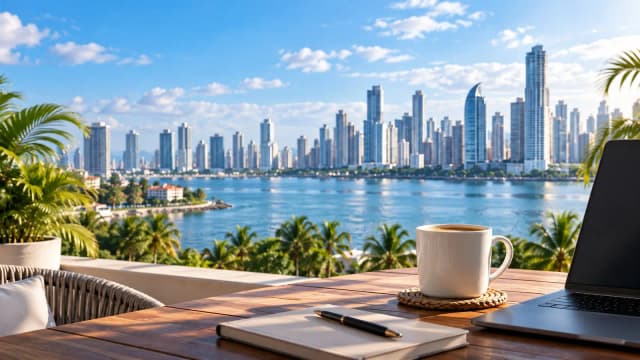
The Jewish neighborhoods of Panama City are concentrated along the waterfront, in modern high-rise towers with ocean views. Families walk to synagogue on Shabbat. Children attend Jewish schools where education runs from kindergarten through high school. After university abroad, they return home.
The community is young demographically, with a strong presence of families with children and a relatively small percentage of elderly members. This is not a community in decline. This is a community that grows.
Shabbat meals take place in homes, at Chabad, at synagogue-hosted lunches. The cholent is famous. The food is described by visitors as succulent, tasty, and abundant.
For tourists, kosher meals can be delivered to hotels and even brought on excursions. On a day trip to an indigenous community accessible only by canoe, a chef cooked kosher fried fish and plantains for 60 travelers.
The predominantly Christian country, encompassing Catholics and evangelicals, shows remarkable alignment with Jewish causes and Israel, rooted in shared Judeo-Christian values. This cultural cohesion creates a harmonious environment that visitors repeatedly describe as exceptional.
Immigration Pathways for Canadians
Canada is on Panama's "Friendly Nations" list, making immigration relatively straightforward.
Friendly Nations Visa: Citizens of 51 countries, including Canada, can obtain residency by demonstrating professional or economic ties to Panama. This typically means:
Since August 2021, the visa initially grants two-year provisional residency. After the two-year provisional period, an eligible applicant may apply for permanent residence and must again demonstrate the applicable qualifying basis. After five years of permanent residency, citizenship is available. Company ownership by itself is not the qualifying basis. Under the Labor Reasons route, the qualifying basis is the genuine labor relationship and the documentation supporting it.
Pensionado Visa: For retirees with a lifetime pension of at least US$1,000 per month, plus US$250 a month for each dependant. A married couple can combine two pensions to reach the US$1,000, and the minimum stays at US$1,000 when they do. This grants permanent residence directly. The Law 6 discounts on healthcare, transportation, restaurants and tourism come from the law, not the visa, and apply to residents from 55 for a woman and 60 for a man, or to anyone drawing a pension at any age. If you purchase real estate worth US$100,000 or more, the pension requirement drops to US$750 per month.
Qualified Investor Visa: For larger investments, this grants permanent residence from approval, under the rules in force since September 2026, with a five-year hold on the investment. The residence can be cancelled if the investment is not maintained for five years, or if a pre-construction purchase is not completed within the limits of the current rules. You may hold the investment personally or through a company, national or foreign, and for property also through a private interest foundation. You must be the final beneficial owner with effective control, and the funds must be yours, sent from abroad, with a paper trail:
Canadians can stay in Panama as tourists for up to 180 days without any visa, making extended exploration visits straightforward.
A Panamanian immigration lawyer is required for residency applications. The process typically takes two to four months, and a visit to Panama is required for medical examination, biometrics, and document submission.
The Practical Details
Currency: Panama uses the US dollar, eliminating exchange rate concerns. For currency conversion and international transfers, a common pairing is a local bank account with Wise.
Time Zone: Eastern Standard Time, same as Toronto and Montreal. No jet lag for East Coast Canadians.
Climate: Tropical, with highs around 90°F and lows around 76°F. The dry season runs from December to April.
Language: Spanish is the official language, though English is widely spoken in business and tourism contexts.
Flight Access: Direct flights from major US cities and connections from Toronto.
Driving: Residents can convert a Canadian license at Sertracen, as set out in converting your Canadian license in Panama.
Cost of Living: Generally lower than major Canadian cities, though Panama City's premium neighborhoods command prices comparable to mid-tier North American cities.
Tax Structure: Panama operates a territorial tax system, meaning only income earned within Panama is taxed. However, Canadians remain subject to Canadian tax obligations on worldwide income. Cross-border tax planning is advisable. For the exit itself, see how the CRA taxes Canadians leaving for Panama.
Healthcare: The new Kesher clinic will offer low-cost care. Private healthcare in Panama City is modern and significantly less expensive than in Canada or the United States.
Apartments: Many buildings in Jewish neighborhoods are designed for observant residents, with Shabbat elevators, double kitchens or separate areas for kashrut, and proximity to synagogues and kosher establishments.
Is Panama Right for You?
Panama offers what Canada increasingly cannot guarantee: the ability to live openly as a Jew without fear.
The infrastructure is comprehensive. The community is welcoming but not casual about who joins. Entry requires demonstrating commitment to Jewish tradition, including confirmation that both parents are Jewish. This is a community that maintains boundaries because those boundaries have allowed it to thrive.
About 20% of the community are Israeli, with many newer arrivals choosing to live near the coast and engaging primarily with Chabad services. Jews from Venezuela, Colombia, Uruguay, and Argentina have found refuge here. Americans are discovering it as a snowbird destination and retirement option.
The question is not whether Panama has what observant Jews need. It demonstrably does. The question is whether the current trajectory in Canada warrants the upheaval of relocation.
That calculation is personal. But the option exists, and it is more established, more sophisticated, and more welcoming than most Canadian Jews realize.
*Plan B Expat specializes in helping Canadians navigate residency pathways in Panama and Paraguay. If you are considering your options, start your pre-qualification assessment or contact us to discuss your specific situation.*
Michael L.
Canadian founder of Plan B Expat. Permanent resident of both Panama and Paraguay. MBA in International Business, trilingual (English, French, Spanish), and two decades of real estate brokerage experience in Quebec and Ontario. Writes from direct experience navigating the immigration, banking, and relocation systems of both countries.