
Most people meet Panama's residency system through the Friendly Nations Visa. Most of them get the same surprise.
The list runs to 50 countries. India is absent. So are Nigeria, the Philippines, Pakistan, Indonesia, Fiji, Vietnam, Egypt, Kenya, Bangladesh, Sri Lanka, Ukraine, Turkey, Morocco and Thailand, along with most of the countries whose nationals go looking for a second residency in the first place.
No structure gets you around it
The List Is Fixed
Executive Decree 226 of 20 July 2021 sets the list. I checked every subsequent decree year through to 2026 to be certain nothing had amended it, and nothing has.
You will read suggestions that a Panamanian company, a local partner or a long stay changes your position. None of that touches nationality. The decree names countries, and either yours appears or it does not.
What happens next is predictable. You get pointed at Qualified Investor or Economic Solvency, both sitting at $300,000, and told those are your options.
They aren't, and the difference costs years.
Follow the commission
Routes Open to Everyone
Only one of Panama's main general categories has a nationality test, though narrower nationality-specific routes exist too, such as the Panama-Italy treaty permit. Here is the whole table.
| Route | Investment or requirement | Open to |
|---|---|---|
| Friendly Nations | $200,000, a fixed deposit, or labor reasons | About 50 countries |
| Qualified Investor | $300,000 | Everyone |
| Economic Solvency | $300,000 | Everyone |
| Forestry investment | $100,000 or $350,000 | Everyone |
| Agricultural investor | $60,000 | Everyone |
| Professional foreigner | A university degree | Everyone |
| Pensionado | $1,000 a month lifetime pension | Everyone |
| Married to a Panamanian | None | Everyone |
Some nationalities need an extra clearance called a visto bueno, requested from the Director of Immigration before filing, which typically adds 30 to 45 days. That's a delay, not a detour. It is not the same thing as the Friendly Nations list, and the two get confused constantly.
So why does every advisory site push the expensive lines in that table?
Because higher-cost programs attract more marketing attention. They involve property, investment projects, banking and additional professional work, so more people have a reason to write about them. A professional visa involves almost none of that, and a university enrollment involves less. The cheaper categories end up easy to overlook.
Neither route below is obscure or difficult. Both come from the same decrees as everything else. Advertising them just does not pay, which is a poor reason for you not to know either exists.
$60,000 in an operating agricultural or aquaculture activity
The Farm Route
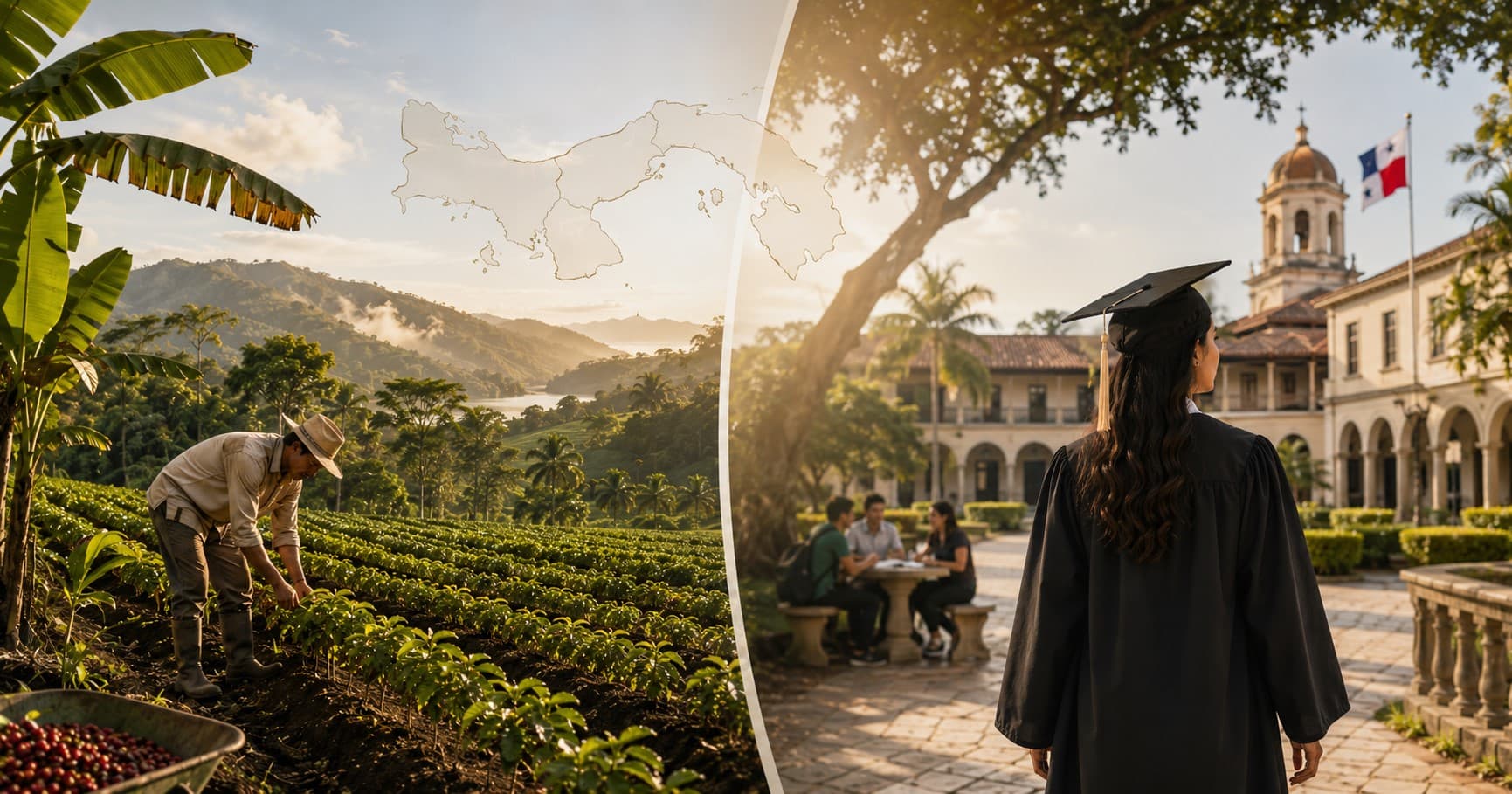
The Agricultural Investor permit needs $60,000 invested personally in agriculture, livestock or aquaculture, in categories the Ministry of Agricultural Development treats as being of national interest.
That undercuts forestry by $40,000 and Friendly Nations by $140,000.
It has to be a working farm. This is the requirement that filters people out, and it should. Your application needs an agricultural registry certification showing the registration number, your payroll, the activity carried out on the finca and where it is located. Add a Public Registry certificate for the land or a lease, an authorized accountant's certification that the capital is yours, and bank certification of the funds.
Buying a field and calling it agriculture doesn't work. The checklist wants the registry certification, the payroll and the activity on the finca, which reads as a category built around production rather than presence. That is my reading of what the paperwork asks for, not a stated minimum number of jobs.
Ownership structure, and here the sources disagree. Migracion's current requirement sheet describes the applicant as having invested "a titulo personal". But Article 96 of Executive Decree 320 says the investment may be made personally or through a legal entity, and Article 98 sets out the corporate documents to file when a company is used, including a sworn declaration of the registered shares issued in the applicant's favor.
So the published checklist is narrower than the decree it implements. That gap is worth money to know about, and it is also a reason not to buy anything through a company before Migracion and your counsel confirm in writing which structure the department is accepting today.
Family members add $500 of investment each, which a local bank reference can evidence. So a couple invests $60,500. Forestry charges $2,000 a head for the equivalent.
One quiet advantage, worth knowing if your paperwork is difficult. Migracion's current agricultural investor checklist unusually permits either a criminal record certificate or a sworn declaration before a notary. Where a home country makes police checks slow, expensive or hard to obtain at all, that removes the commonest cause of delay.
And an obligation the investment routes do not carry. Renewal requires a Paz y Salvo Nacional de Rentas, a national tax clearance certificate. Stay tax-compliant in Panama or the permit stops renewing.
Fees. Legal and government costs are quoted at consultation rather than published, since they move with family size, document count and your country of origin. What is worth knowing in advance is the shape: two government checks per applicant, professional fees on top, and official Spanish translation billed separately.
The question everyone gets wrong
Year Six
The permit runs in two-year periods to a maximum of six years. Then it stops, with nothing beyond.
Some articles claim the status expires and you must leave. Others imply it rolls into permanent residency. I put the question to Panamanian counsel because neither sounded right.
His answer: the category doesn't lead automatically to permanent residency. Once the maximum period is exhausted, a foreigner wanting to stay must assess whether he meets the requirements of another immigration category and file a fresh application under that category's own rules. The change is not automatic. It depends on which subcategories are in force at the time.
Six years of lawful residence, then the same decision you faced at the start.
Be clear on what those six years do not buy. No reduction in any other category's threshold. No lower fees. Nothing toward citizenship, since Panama's five-year naturalization clock runs on permanent residency and this permit stays temporary throughout.
Spend $60,000 here, then want the $100,000 forestry route, and you still need the full $100,000.
So why would anyone do it?
Because the permit and the land are separate things, and only the permit expires.
The immigration permit and the farm arrangement are separate things. If you bought the finca, title stays yours. If you leased it, your rights run on the lease, since Migracion accepts either a Public Registry certificate for the land or a lease contract. Either way the arrangement has to keep meeting the requirements at renewal. And this is an operating business, which forestry isn't: there your money transfers to a reforestation company and teak gets harvested somewhere between 15 and 25 years out. Fruit produces every season instead. The $60,000 works rather than waits.
Could the farm itself carry you onward? That was my question, and counsel's answer deserves quoting rather than summarizing.
No provision exists under which a finca acquired under the agrarian regime becomes a valid investment for the Qualified Investor or Economic Solvency categories on reaching a given value. A new application would have to comply in full with the requirements of the category being moved to. If at year six the property is worth $300,000, is free of liens where applicable and meets all the Qualified Investor requirements, there would legally be arguments to try to structure an application on that property. The type of property and the way the investment was documented would still have to be verified as acceptable for that category.
Then he volunteered something I had not asked for. If a client believes he can raise $300,000 in the short term, counsel says it is usually more convenient to analyze the Qualified Investor route from the start. That avoids depending on a category change years out, and it removes the uncertainty of not knowing which requirements will be in force by then.
A lawyer talking a client out of the cheaper first step is worth listening to.
No investment at all
The Study Route
Executive Decree 3 of 6 February 2026 opened a category that did not exist before. A person who has completed, or is completing, more than six consecutive years of qualifying study in Panama may apply under the new subcategory. The initial permit is provisional for two years, and only after that period may the person apply for permanent residence. So it is more than six years of study, then two more, then the application.
No age ceiling applies. Counsel confirmed the decree sets none, though it has separate filing provisions for minors. Someone starting in their twenties qualifies, and so does someone considerably older.
Through those years you hold a temporary residence permit for education reasons, renewed as you keep meeting the academic requirements. The permit itself is among the cheapest Panama issues, a fraction of any investment route before you even count the investment.
Two limits matter more than the price.
The student permit itself authorizes study, not employment. Migracion's older education checklist put it flatly. But MITRADEL's current Type 6B rules let students in technical, bachelor's, postgraduate, master's or doctoral programs lasting at least two years apply separately for permission to work, either for themselves or for an employer, where the work is compatible with their studies. Primary and secondary students fall outside that published rule.
So residence and the right to work are two applications, not one, and a university student can reach the second earlier than people assume.
You need to prove sufficient funds, and the checklist offers several ways: a scholarship, proof of financing, a bank letter for you, or a bank letter for a responsible person. A persona responsable and a responsibility letter are needed only where a third party is supporting the application, so this is less of an obstacle than it is usually described as, provided your own funds or a scholarship carry the file.
Work becomes possible afterwards, though not automatically. Holding permanent status means you are no longer under a purely student immigration status, so you may apply to the Ministry of Labor. The permit still has to be applied for and to meet the labor requirements in force at the time.
Call it eight years and more, plus processing, to reach permanent residency by that route. The right to work can come earlier through a separate Type 6B permit while you are still studying.
The route almost nobody mentions
The Professional Visa
Here is what makes the study route interesting, and it is not the study route.
Panama has a category for foreign professionals. It requires a university degree in a profession the Constitution does not reserve to Panamanian nationals. No employer, no investment, and no nationality restriction.
Counsel's words when I asked whether it converts: applicants get a provisional card for two years and then permanent residency, and no employer is necessary, because the degree suffices.
Cost: among the lowest of any Panamanian residency route, covering professional fees and the government charges. Family members added to the same application cost less each. Figures are quoted at consultation.
Set that beside $300,000 and five figures in fees on the Qualified Investor route, for the same permanent residency at the end.
One condition attaches. A degree earned outside Panama must first go through convalidacion, a formal recognition process before the Panamanian authorities. That costs time and money, and I am still establishing how much of each.
A degree earned in Panama skips it entirely. Counsel was explicit. Anyone who obtained their licenciatura, postgrado or maestria in Panama, or who arrived as a student and completed their studies in the country, applies directly with no convalidacion at all.
Put those two facts together and the arithmetic shifts. A four-year degree taken in Panama, followed by the professional visa, reaches permanent residency in about six years with no recognition step. The Decree 3 route wants more than six years of study before you start. Same destination, and you finish holding a qualification worth something.
This category also admits dependents. Counsel called it an attractive option for family units for exactly that reason.
Which sets up the most useful thing on this page.
The problem nobody writes about
The Adult Child Problem
Every Panama residency article assumes a tidy family. Two parents, small children, one application.
Reality looks different. A family plans a move, the children are 19, 22, 24, and somebody discovers late that the rules do not work as assumed.
An adult child counts as a dependent between 18 and 25 only, and three conditions must hold at once. Studying full time. Unmarried. Financially dependent on the principal applicant.
Age alone disqualifies nobody. A 22 year old studying and single qualifies. A 22 year old who isn't studying does not. That distinction catches families out, because they hear "under 25" and stop reading.
The standard dependent-child rule stops accepting new applicants once they are over 25. What the published rule doesn't explain is what happens to a dependent permit already granted when the holder reaches that age, and that is a question I have put to counsel and not yet had answered. Does a dependent convert to permanent residency in her own right, or does she have to change category entirely? I am not going to guess at it here. Families make decisions on this, and a confident wrong answer does more damage than an open one.
Three ideas get suggested constantly and none of them works.
Making your child a director or manager of your Panamanian company creates nothing. Panama has no residency category for holding a position in a company.
Adding your child to the forestry company alongside you fails too. The decree requires each foreigner applying through the same entity to have personally made the full minimum investment. Two people on the permanent forestry route means $200,000, not $100,000 shared. Get it wrong and the application is canceled, with an obligation to leave the country attached.
Enrolling them in study does restore eligibility as a dependent, which is real and useful, and the rule stops offering it above 25. What the rule doesn't say is what happens to a dependent permit already granted when the holder turns 25, so treat that as unsettled.
What does work. The professional visa, if your child holds a degree. Failing that, a degree taken in Panama, then the professional visa on graduating with no recognition step in the way.
Then the inversion. Article 224 lets dependent parents of a provisional resident, permanent resident or national apply under family reunification. So once the graduate holds qualifying residence, a financially dependent parent may be able to apply in turn, as a separate application with its own solvency and supporting documents rather than an automatic entitlement. For a family with no qualifying capital and one graduate, that isn't a footnote. That is the plan, subject to the requirements in force when they get there.
Choose by what you want to do
Farm or Degree
Farm if you want to work land in Panama, $60,000 is near your ceiling, and six years followed by a decision is acceptable. If you bought the finca rather than leasing it, the title stays yours whatever the permit does. Don't pick it as a cheap first step toward something bigger, since counsel's own advice runs against depending on a category change years out.
Degree if anyone in the family already holds one. For a foreigner with no Panamanian spouse and no pension, this is the cheapest route to permanent residency Panama offers. It goes unmentioned because there is nothing in it for whoever is selling.
A degree in Panama, then the professional visa where there is a young adult with time and no qualification yet. Six years, a degree worth having, permanent residency at the end.
The Decree 3 route only where long study in Panama is already happening for its own reasons and no degree is being taken.
None of these if you draw a pension already. Pensionado grants permanent residency immediately, ignores nationality, and costs a fraction of everything above. Different article.
What is still open
Every figure here comes from Panamanian counsel's written schedule or from the government's own requirement sheets. Where a question remains unresolved I have said so, rather than filling the gap with whatever circulates online.
Four things remain unsettled as I write. What convalidacion of a foreign degree costs and how long it takes. Whether a dependent converts at 25. What enrollment documentation the student permit requires, and who can serve as persona responsable. Whether an eco-tourism or retail component alongside a farm is permissible at all, given that retail trade is constitutionally reserved to Panamanian nationals.
Anyone who tells you those are settled should be asked for the instrument.
Last updated: August 2026. Figures confirmed with Panamanian counsel and checked against the immigration service's own requirement sheets and the governing decrees. Requirements change, and we re-confirm them before every client engagement.
Michael L.
Canadian founder of Plan B Expat. Permanent resident of both Panama and Paraguay. MBA in International Business, trilingual (English, French, Spanish), and two decades of real estate brokerage experience in Quebec and Ontario. Writes from direct experience navigating the immigration, banking, and relocation systems of both countries.