Almost every article about Panama reforestation quotes one number. Panama runs two separate forestry permits with different floors and very different outcomes.
Mix them up and it costs you, because one of them never leads to permanent residency.
Two Permits, Not One
Panama's Servicio Nacional de Migración publishes these separately.
| Permit | Minimum | What you get |
|---|---|---|
| Temporary forestry investor (PPT-IFOR) | B/.80,000 | Temporary residence, renewable. Does not itself lead to permanent residency |
| Provisional permit for permanent residency (PPT-RR) | B/.100,000 | Provisional first, then apply for permanent residency |
| Automatic permanent residency | B/.350,000 | Permanent residency directly, no provisional stage |
Balboas are pegged one to one with the US dollar, so these are dollar figures. Each adds B/.2,000 per dependent.
The $100,000 and $350,000 tiers come from Article 180 of Executive Decree 320 of 2008, as modified by Executive Decree 199 of 7 May 2021. The $80,000 permit is a different category altogether, filed under temporary residence for investment reasons.
This is why the quoted figures never agree. Firms quoting $100,000 are right about the permanent route. The $80,000 figure is real too, but it buys you less.
The Company Rule Nobody Publishes
You can make the investment personally or through a legal entity. Most articles stop there. The decree doesn't.
Each foreigner applying through the same company must have personally made the full minimum investment. Article 181 for the permanent route, Article 101 for the temporary one.
So a couple using one company on the permanent route needs $200,000, not $100,000 shared. Three people need $300,000. There's no volume discount and no way to spread one investment across a family.
The temporary permit goes further and caps it: a maximum of two foreigners per entity, each having invested the full B/.80,000.
And the penalty for getting this wrong isn't a rejection letter. Both articles use the same wording: failure to meet the requirement causes cancellation of the application and an obligation to leave the country.
If you are planning a structure that puts a spouse or an adult child on a company to bring them in, this is the paragraph that breaks it. Family members come in as dependents, at $2,000 of additional investment each, not as co-owners of the same stake.
Which One Do You Want
If you want permanent residency, your floor is $100,000, not $80,000. That's the number to budget against.
The $80,000 permit is worth knowing about if permanent residency is not the immediate goal, if you want legal residence at lower cost while you decide, or if you are testing Panama before committing more capital. It is renewable, and renewal requires certification that the investment is still in place and that the forestry company's registration remains valid.
$350,000 buys speed. You apply directly for permanent residence with no provisional stage. Decree Law 3 sets a general decision period of up to 60 business days, though timing varies if Migracion asks for corrections. Whether that premium is worth skipping the provisional years is a personal calculation.
Investment Details
Permanent route, from $100,000
Automatic permanent, from $350,000
Temporary route, from $80,000
Some project operators offer packages described as $90,000 toward the forestry interest plus $10,000 toward maintenance or management, with legal and service fees on top. Before you accept that structure, ask counsel to confirm in writing that the maintenance portion counts toward the legal minimum, because the accountant's certification has to state the sum invested directly in reforestation, and a management fee is arguable. If it doesn't count, your $100,000 package is a $90,000 investment and the file is short.
One line in the decree tells you what you are buying. Article 183 requires proof of investment in the form of a bank certification of the transfer of funds to the reforestation company, alongside share certificates or a commercial contract with it.
So buying land alone doesn't qualify. The investment has to be made directly into a forestry or reforestation activity registered with the Ministry of Environment, and documented through the ownership, contractual, corporate and payment evidence Migracion requires. Personal title can form part of that picture, but title by itself is not the qualifying fact.
That isn't a criticism of the route. It's what the route is, and it's the most useful thing to understand for anyone picturing themselves living among their own trees. If you want land you work yourself, ask about the agricultural route instead.
How It Works
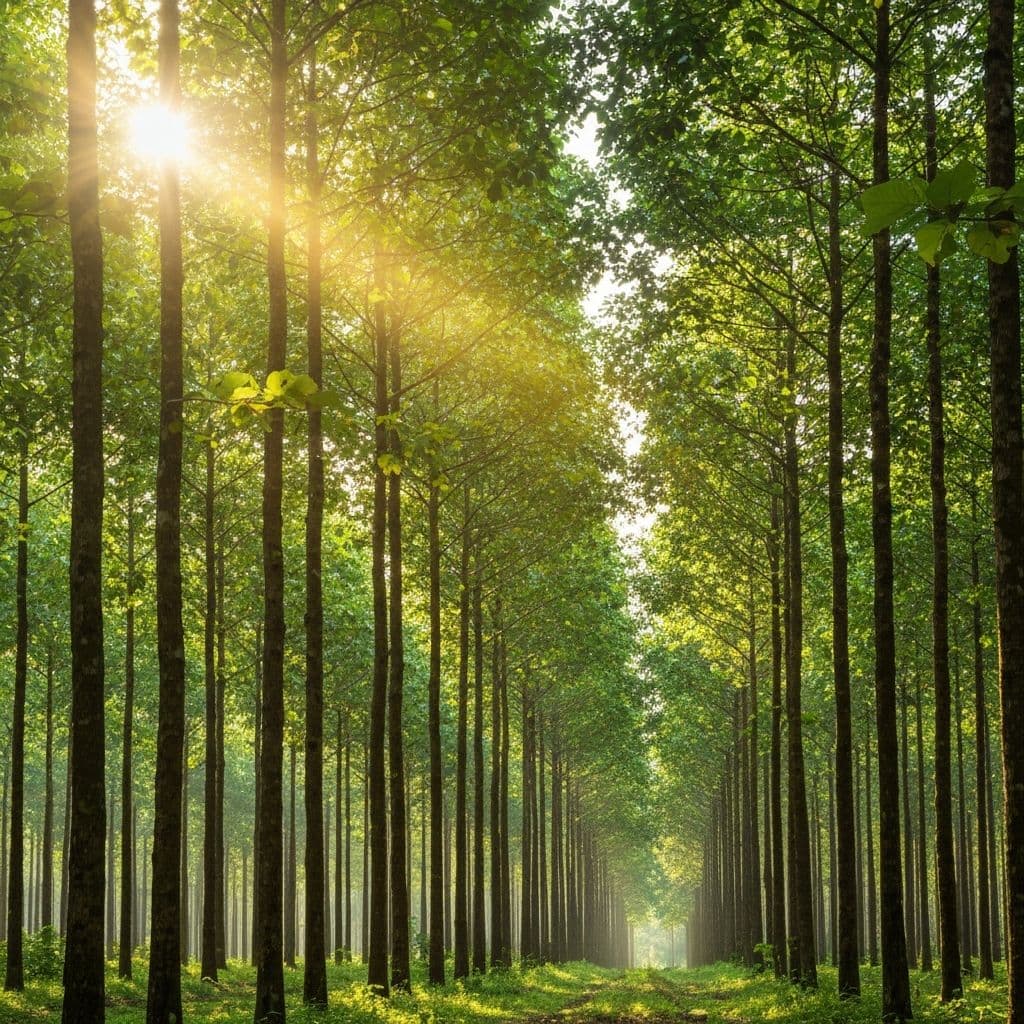
You invest in a project holding a forestry registration resolution from Panama's Ministry of Environment. These are usually teak, pine, mahogany or mixed native species plantations. Other activities may qualify only where the Ministry has specifically authorized and registered them, so treat any wider claim as something to verify against the resolution itself.
Your stake is evidenced either by share certificates in the project company, or by a commercial contract with the company holding those certificates. The operator handles planting, maintenance and harvesting.
What does not qualify. Buying land to farm yourself, or running an eco-tourism business, is something else entirely. The Ministry of Environment registration is what makes an investment count. If a working farm is what you want, Panama has a separate agricultural investor category, and that is the one to ask about.
Timeline
Permanent route ($100,000)
Direct permanent ($350,000)
Temporary route ($80,000)
Required Documents
Broadly the same across the permits:
Personal
Proving the investment
Government checks
At the permanent residency stage, the same documents are filed again, without the criminal record certificate and without the checks, plus certification from the reforestation company that the investment remains in place and certification that the company's forestry registration is still valid.
Holding the Investment
People underestimate this part.
The investment must be maintained for at least five years after permanent residency is granted. Proof must be filed annually, counted from the date the permanent residency permit is approved.
If the investment ends before those five years are up, Panama can cancel the permanent residency, not suspend it.
Plantation maintenance is normally budgeted across about eight years, and teak harvest cycles run 15 to 25 years. Three separate clocks, and people mash them together constantly.
Costs
| Item | Temporary | Permanent route | Automatic |
|---|---|---|---|
| Minimum investment | $80,000 | $100,000 | $350,000 |
| Per dependent | $2,000 | $2,000 | $2,000 |
| Government checks | $1,050 | $1,050 | $1,050 |
| Residency granted | Temporary | Provisional, then permanent | Permanent directly |
Legal and government costs come on top of all this, and they are separate from the investment in every sense. Two government checks are required for each applicant, one to the National Treasury and one to the immigration service, and dependents carry them as well. Then professional fees, the residency cards, notarial costs, official Spanish translation, project charges, travel, apostilles and document costs at home.
We quote those at consultation rather than publishing a figure, because they move with family size, document count and your country of origin.
What matters more than the number is the shape of the quote. Professional fees and government charges are different things, and firms often bundle them into one vague figure. Ask for the split in writing, and ask whether the conversion to permanent residence is included or billed again later. A firm that will not separate them is telling you something.
Benefits
Not restricted by nationality. No country list, unlike the Friendly Nations Visa. For applicants ruled out of the cheaper options by their passport, this is one of the few investment routes open to them.
One of the lowest capital thresholds. Among Panama's principal investment-based routes to permanent residence, $100,000 undercuts Friendly Nations at $200,000 on its investment route, and Qualified Investor and Self-Solvency at $300,000. Non-investment categories such as Pensionado can be cheaper still if you qualify for them.
A real asset rather than a deposit. You hold an equity or contractual interest in a forestry project, with potential returns at harvest.
Tax, banking and presence, stated carefully. Panama generally applies territorial income-tax principles, but immigration status and tax treatment are separate questions and the classification of your income depends on the facts. Residence can help with banking, though each bank applies its own compliance and source-of-funds requirements. The published forestry rules state no annual minimum stay, but permanent residence may be canceled after an absence of more than two years unless the absence was justified and authorized.
On citizenship, be careful what you are told. The five-year count toward naturalization cannot start before the resolution granting permanent residence, which on the $100,000 route arrives about two and a half years in and on the $350,000 route arrives at the start. And the years only count to the extent you were living in Panama, since immigration reviews your entries and exits. A card held from abroad doesn't build them.
Work authorization is not automatic. The permit doesn't carry a work permit, though permanent residents can normally apply for one separately.
Choosing a Project
Registration. Ask to see the Ministry of Environment resolution itself, not somebody's summary of it.
Track record. How long has the operator been going, and what have they delivered so far?
What the money buys. At $100,000, what parcel and how many hectares? Compare across operators.
Exit. What happens if you need out before the five-year hold ends? Is there a buyback, or a secondary market?
Annual reporting. Who produces the yearly certification you must file? If the operator is unreliable about paperwork, your residency depends on it.
I can provide introductions to vetted project operators.
And before you wire anything, have somebody independent check the project itself. Migración approving your file says nothing about whether the operator can deliver.
Reforestation vs Other Panama Options
| Feature | Reforestation | Friendly Nations | Qualified Investor | Self-Solvency |
|---|---|---|---|---|
| Minimum for permanent path | $100,000 | $200,000 | $300,000 | $300,000 |
| Eligible countries | ALL | Listed nations only | ALL | ALL |
| Time to permanent | 2.5 to 3 years | 2.5 years | Weeks | 2.5 years |
| Fast option | Yes, at $350K | No | Already fast | No |
| Hold requirement | 5 years after PR, annual proof | Varies by route | 5 years | Varies |
| Liquidity | Very low | Moderate | Moderate | Moderate |
Choose reforestation if your passport rules out the Friendly Nations Visa, you want a low capital threshold among the investment routes, and you can leave money in an illiquid asset for years.
Choose something else if you need residency quickly and have $300,000, you want to be able to exit, or you qualify for Friendly Nations, which is simpler.
Is This Right for You?
It fits if you hold a passport outside the Friendly Nations list, want one of the lowest capital thresholds among the investment routes, and can commit capital for at least five years past approval.
It doesn't fit if you need speed, want liquidity, or expect the investment to behave like a financial product.
The mistake almost everyone makes is assuming there's one permit and one price. There are three tiers, and only two of them get you permanent residency.
Last updated: August 2026. Written from the decree texts and the immigration service's own requirement sheets, and confirmed with licensed Panamanian counsel. Requirements change, and we re-confirm them before every client engagement.
Plan B Expat provides consulting and coordination, not legal or tax advice. Always take counsel from the licensed attorneys, accountants and tax specialists in our vetted network.
Michael L.
Canadian founder of Plan B Expat. Permanent resident of both Panama and Paraguay. MBA in International Business, trilingual (English, French, Spanish), and two decades of real estate brokerage experience in Quebec and Ontario. Writes from direct experience navigating the immigration, banking, and relocation systems of both countries.