Flip it over. It's completely different.
Paraguay's flag is the only national flag in the world with two distinct designs - not mirrored, not reversed, but genuinely different images on each side. The front shows the national coat of arms with a star for independence. The back shows a lion guarding a liberty cap with the motto "Peace and Justice."
Every other country's flag looks the same from both sides (or is simply reversed, like Saudi Arabia's to keep sacred text readable). Paraguay alone decided: why settle for one symbol when we can have two?
Here's what each side means and how this unusual flag came to be.
Why no other flag does this
Moldova mirrors its coat of arms on both sides. Saudi Arabia duplicates its design so the text isn't reversed. But Paraguay is the only sovereign nation with genuinely different emblems front and back.
The practice dates to José Gaspar Rodríguez de Francia, Paraguay's first dictator (1814-1840), who admired Napoleon and adopted the French tricolor's colors. Having two distinct emblems - state authority on one side, civic virtue on the other - reflected his vision of a republic that balanced power with justice.
Front: The Star of May
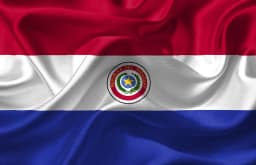
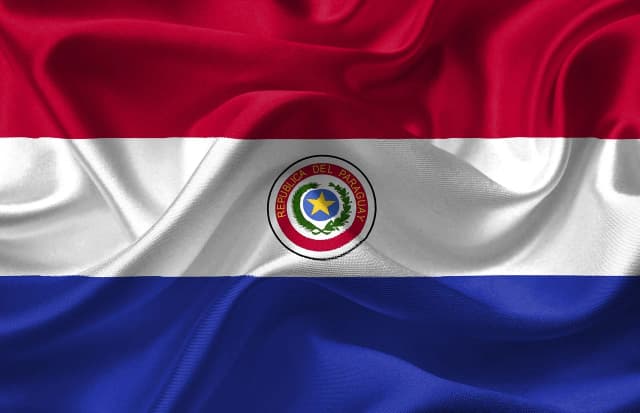
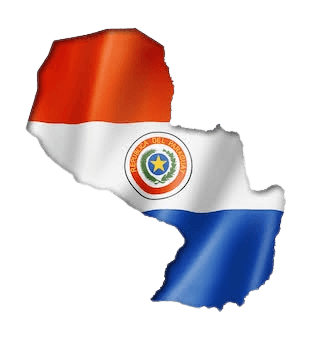
The obverse shows Paraguay's national coat of arms: a golden five-pointed star (the "Star of May") surrounded by a green wreath of palm and olive branches, encircled by the words "República del Paraguay."
The star recalls May 1811 - the month Paraguay declared independence from Spain. Palm represents victory; olive represents peace. The wreath ties together with ribbons matching the flag's colors.
Back: The Lion of Liberty
The reverse shows the Treasury Seal: a golden lion facing east, guarding a staff topped with a red Phrygian cap - the classical symbol of freedom that freed slaves wore in ancient Rome.
Above the lion: "Paz y Justicia" (Peace and Justice). The message is clear - Paraguay will defend its liberty with strength, but its goal is peace.
How the flag evolved
Paraguay's flag went through several designs before landing on the current one:
1811 (May-June) The "Blue Flag" - solid royal blue with a white six-pointed star, honoring the Virgin Mary of Asunción
1811 (June-August) Red, yellow, and blue stripes - borrowing from Spain's colors while adding blue for independence
1812 The first red-white-blue tricolor appears, inspired by the French Revolution's ideals of liberty
1842 The current design is formally adopted on November 25th, adding both emblems to the white stripe
The colors came from France - José de Francia admired the revolution's principles - though some historians note the Dutch flag (same colors) may have also influenced the design.
The 2013 cleanup
On July 15, 2013, President Federico Franco approved changes to restore the emblems closer to their original 1842 form:
A proposal to replace the palm and olive branches with native pindo palm and yerba mate was rejected - some traditions are harder to change than others.
Flag Day: August 14
Paraguay celebrates Día de la Bandera on August 14th - deliberately scheduled one day before the Founding of Asunción (August 15th) so the two celebrations don't compete.
The date was chosen in 1913 at the request of the Teachers' Association. Schools hold ceremonies teaching the flag's history, and the day is marked with official events at government buildings and military bases across the country.
The Song Everyone Knows
Composer Mauricio Cardozo Ocampo wrote "Qué Linda Es Mi Bandera" (How Beautiful Is My Flag) - a seven-verse song taught in every Paraguayan school. It's the unofficial anthem of national pride, and most Paraguayans can sing at least the first verse from memory.
Three streets in downtown Asunción are named after elements of the flag: Calle Palma (palm), Calle Estrella (star), and Calle Oliva (olive).
Photo Gallery